Located in the heart of Juneau, Juneau International Airport serves as the primary air gateway to Alaska’s capital city. Surrounded by mountains, wetlands, and coastal waters, it is one of the most uniquely situated airports in the United States, providing essential connectivity to a city that has no road access to the rest of the state.
As both a transportation hub and a critical infrastructure asset, the airport plays a central role in linking Juneau to Alaska, the Lower 48, and beyond.
A Remote Capital Connected by Air
Unlike most U.S. state capitals, Juneau is not accessible by highway. Travelers must arrive by air or sea, making Juneau International Airport one of the city’s most important lifelines.
The airport connects Juneau to major hubs such as Anchorage, Seattle, and other regional communities across Southeast Alaska. These routes support government operations, tourism, healthcare access, and daily commerce.
For many visitors, the airport is their first introduction to Alaska’s capital offering immediate views of glacier-carved mountains and dense coastal rainforest as the aircraft descends into the valley.
A Runway Surrounded by Wilderness
One of the most striking features of Juneau International Airport is its setting. The airport sits in the Mendenhall Valley area, surrounded by steep mountain ranges and wetlands that are part of the broader Tongass National Forest ecosystem.
Aircraft approaches are known for their dramatic scenery. Pilots navigate between mountain ridges and coastal inlets before landing near sea level, creating one of the most visually memorable airport arrivals in North America.
Despite its remote feel, the airport is located just minutes from residential neighborhoods, shopping areas, and government facilities.
Essential Transportation Hub for Alaska’s Capital
Juneau International Airport is not only a passenger terminal it is a critical infrastructure hub for the entire region. It supports:
- Commercial passenger flights
- Air cargo and freight delivery
- Medical transport services
- Government and emergency operations
- Mail and essential supply logistics
Because Juneau is isolated from the road system, the airport plays a vital role in ensuring that goods, services, and people can move in and out of the city efficiently.
This makes it a cornerstone of both daily life and long-term regional development.
Connecting Visitors to Alaska’s Capital Experience
For tourists, the airport is the primary entry point into Alaska’s capital region. After landing, visitors are quickly transported to key destinations such as Downtown Juneau, the Mendenhall Glacier, and surrounding coastal attractions.
Its proximity to major attractions means travelers can transition from runway to rainforest in a matter of minutes. This immediate access to nature is one of the defining characteristics of the Juneau travel experience.
Gateway to the Inside Passage
Juneau International Airport also supports travel throughout Southeast Alaska’s Inside Passage region. From here, passengers connect to smaller communities that are otherwise accessible only by air or boat.
These connections are essential for residents living in remote villages, as well as for tourism and supply chains that support the broader region.
The airport’s role as a connector reinforces Juneau’s position as a central hub in Alaska’s coastal network.
Weather, Terrain, and Operational Challenges
Operating an airport in Juneau comes with unique environmental challenges. The region experiences frequent rainfall, low cloud cover, and rapidly changing weather conditions due to its coastal and mountainous geography.
Pilots must navigate carefully between terrain and weather systems, especially during winter months when visibility can be reduced.
Despite these challenges, the airport maintains consistent operations through advanced navigation systems, experienced pilots, and specialized infrastructure designed for Alaska’s conditions.
Modern Facilities with a Local Feel
While relatively small compared to major urban airports, Juneau International Airport offers modern facilities tailored to regional needs. These include:
- Passenger terminals with regional and commercial services
- Car rental and ground transportation options
- Cargo handling facilities
- Aviation support services
The airport is designed for efficiency rather than scale, reflecting Juneau’s population size and remote location.
Its layout allows for easy navigation, with short walking distances between arrival gates, baggage claim, and transportation areas.
Economic Importance to the Region
The airport is a major driver of Juneau’s economy. It supports tourism, which is one of the city’s largest industries, especially during summer cruise and travel seasons.
It also facilitates government operations, medical access, and business travel, ensuring that Alaska’s capital remains connected despite its isolation.
Cargo flights bring in essential goods, including food, medical supplies, and retail products, helping sustain the local economy year-round.
Without the airport, Juneau’s economic and logistical systems would face significant limitations.
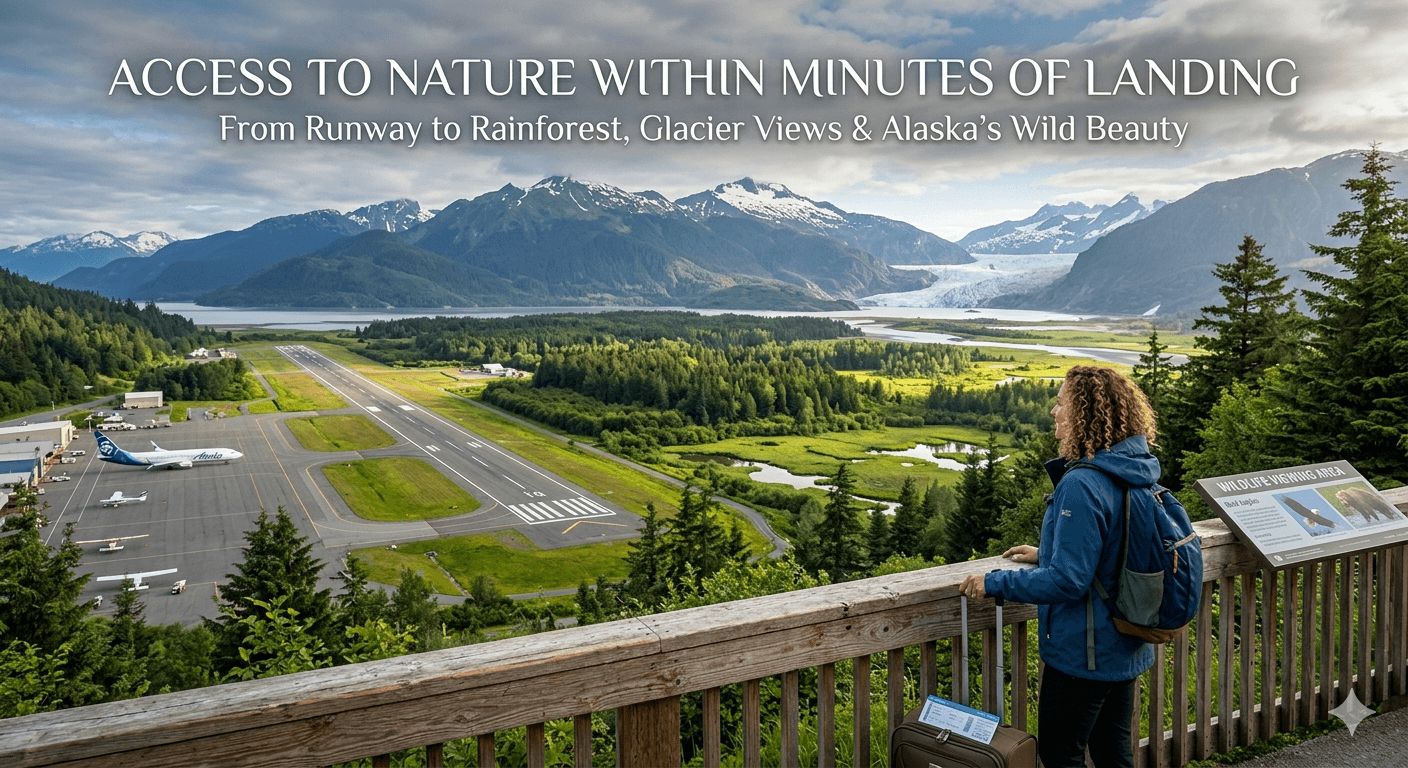
Access to Nature Within Minutes of Landing
One of the most distinctive aspects of arriving at Juneau International Airport is how quickly travelers transition into natural landscapes.
Within a short drive, visitors can reach:
- Rainforest trails
- Coastal viewpoints
- Wildlife observation areas
- Glacier access routes such as Mendenhall Valley
This immediate connection to nature sets Juneau apart from most capital cities, where airports are typically surrounded by dense urban development.
In Juneau, the airport sits within a landscape where wilderness begins almost immediately beyond the runway.
Seasonal Travel Patterns
Air traffic at Juneau International Airport varies significantly throughout the year.
Summer brings peak tourism activity, with increased flights supporting cruise passengers and outdoor recreation visitors. This is the busiest season for both arrivals and departures.
Winter sees reduced tourism but steady government and resident travel, particularly during legislative sessions in Alaska’s capital.
Spring and fall serve as transitional periods, with moderate travel demand and changing weather conditions influencing flight schedules.
A Lifeline for a Remote Capital City
Ultimately, Juneau International Airport is more than a transportation facility it is a lifeline for Alaska’s capital.
It connects residents to essential services, enables tourism, supports government operations, and ensures the flow of goods into a city that cannot be reached by road.
For travelers, it serves as the gateway to one of the most unique capital cities in the world where mountains rise directly from the coastline, glaciers sit near residential neighborhoods, and wilderness begins just beyond the runway.
In every sense, the airport defines access to Juneau, making it the essential starting point for experiencing Alaska’s capital and its surrounding natural wonders.